Commercial Licensing for Generated Video
Commercial licensing for generated video does not scale with render volume: Editframe gates its paid tiers by employee count, not by how many videos a team renders, while FFmpeg's LGPL license and MoviePy's MIT license carry no such gate at any size. The TPL-30 benchmark measures what each tool actually costs to run before that license gate applies.
The question, and the number that answers it
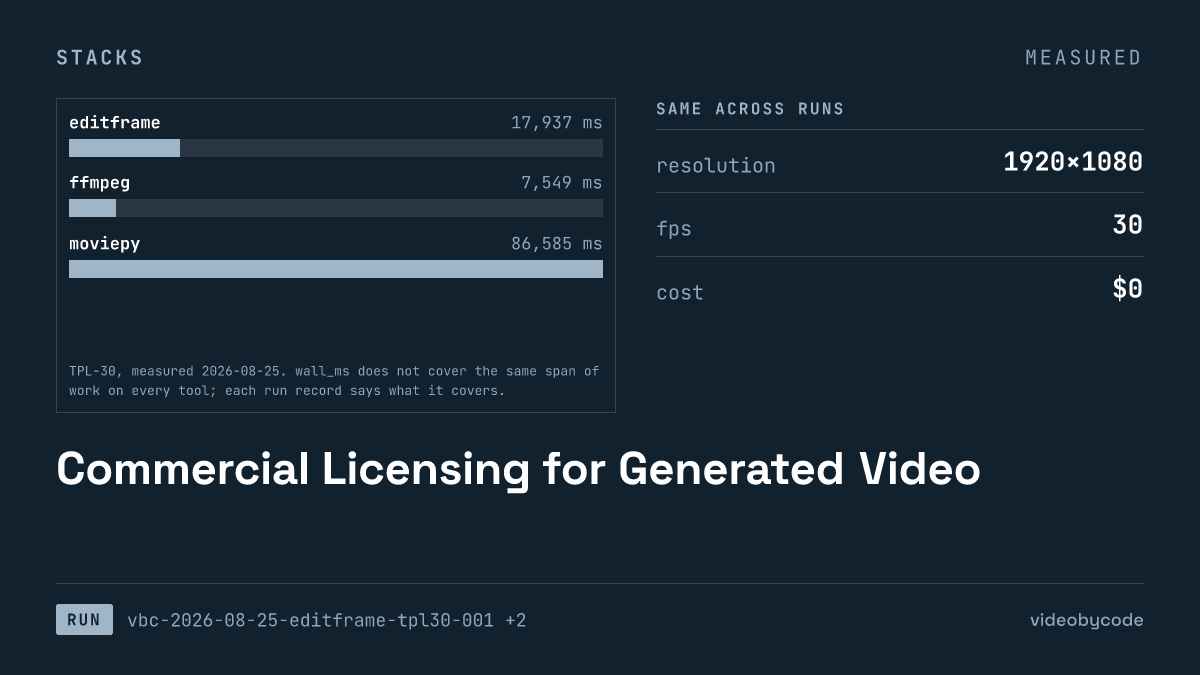
Editframe renders the TPL-30 benchmark locally, under its free tier, in 17.9 s, and the resulting file is 1.46 MB, but that number has no bearing on Editframe's commercial license for generated video. Its two paid tiers, Team at $49 a month and Cloud at $99 a month, are not billed by render count or by wall time. They are billed by employee headcount, because the free tier's condition is companies of three employees or fewer, not a volume cap.
That gate is why a commercial license for generated video, in Editframe's case, is a headcount question rather than a throughput question. FFmpeg and MoviePy carry no paid tier at all: FFmpeg's LGPL v2.1-or-later license and MoviePy's MIT license both cost $0 and $0 respectively, at any volume, because open-source licensing does not meter usage in the first place. Remotion sits between the two models. It stays free for individuals, non-profits, and companies of three employees or fewer, with unlimited renders inside that condition, but its license file is silent on what a fourth employee costs, because the vendor has not published a price for the paid license anywhere in the source checked for this article.
A technical lead weighing build versus buy for a commercial license for generated video, pricing a rendering pipeline for a company of five people, cannot use render volume to choose between Editframe's free tier and its paid ones, and cannot use it to price Remotion's paid license either. The variable that matters is headcount, not throughput, and none of the four vendors compared here price a render the same way twice.
Editframe's own pricing page states the free plan runs at zero cost forever for companies of three employees or fewer, and specifies commercial use is allowed on it. The run that produced the 17.9 s figure used no account, no API key, and no cloud endpoint, which is what "local/browser rendering" means on that tier in practice. What follows works through what a team gives up by staying on that tier, and what the two paid tiers add once headcount forces the question.
What the self-hosted side costs to run
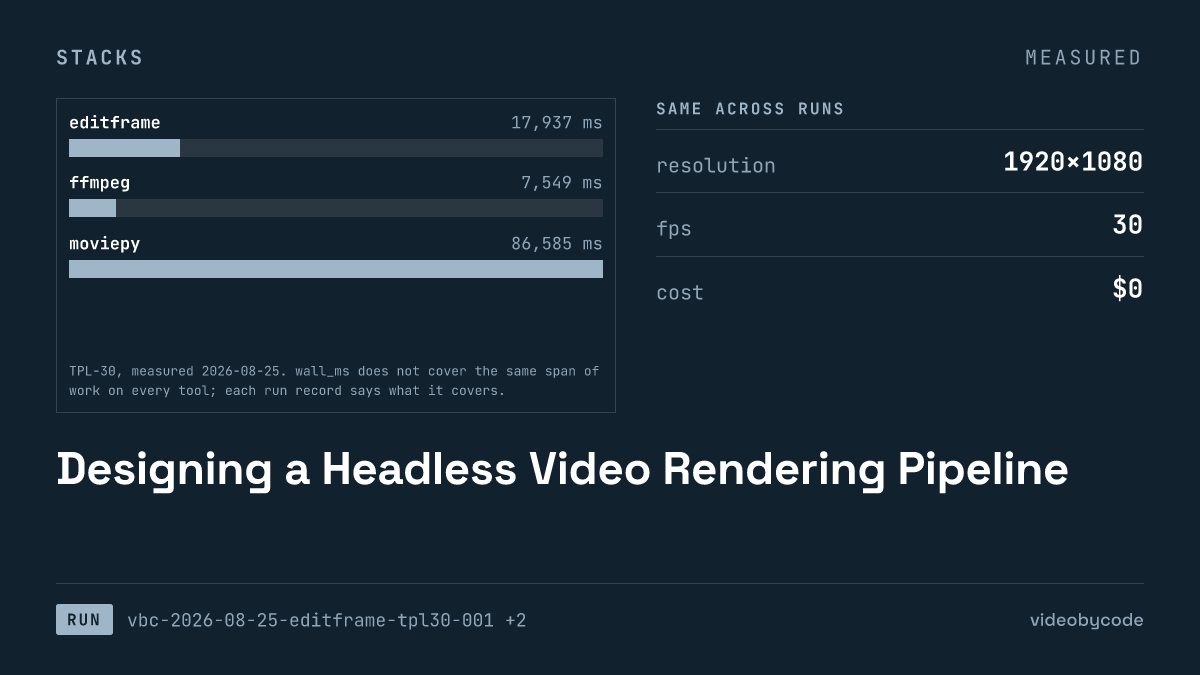
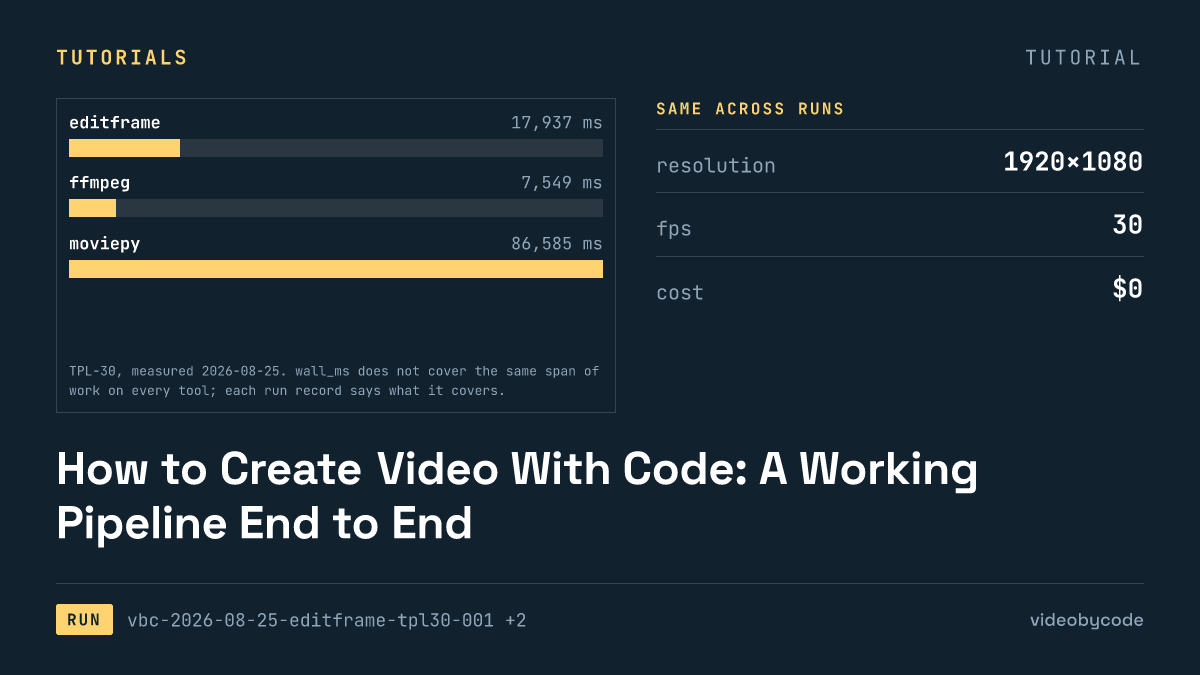
The 17.9 s figure is not encode time. It covers the full invocation: Vite dev server startup, a system Chrome launch through Playwright, per-frame capture across the whole render, and a WebCodecs encode, all inside one measured span, with EF_NO_TELEMETRY=1 set to suppress the CLI's telemetry request. That makes it directly comparable to the Remotion run in this same benchmark set, which also folds bundling, browser launch, and capture into one span, and not comparable to a bare FFmpeg invocation, which skips browser rendering entirely and only encodes.
Two exclusions matter for anyone estimating what this costs at scale. First, the dev media server that Editframe's CLI starts decodes and caches the image assets on first request. The benchmark harness emptied the cache directory before this run, so 17.9 s includes that cold-cache decode rather than the warm-cache reuse a second render on the same machine would get. A queue of renders on one host would not each pay that cost the way this single measurement does. Second, the CLI exposes fps, scale, and codec selection, but no CRF, no preset, and no pixel-format flag. The browser's own encoder produced the 1.46 MB file at 30.080 s at whatever bitrate it chose, not at the crf=20, preset=medium settings the FFmpeg and MoviePy payloads in this benchmark set were told to hold. A size comparison across tools has to account for that gap in control, not read the file size alone as a fair fight.
One property surfaced during this run belongs in a licensing decision, not just a performance one. An ef-image element has no natural duration and defaults to zero: Editframe silently never draws an image that carries no explicit duration attribute, and the render still finishes, reporting a complete frame count over a black picture instead of erroring. A team evaluating Editframe for production needs to catch that in code review, because neither the free tier's price nor the paid tiers' price will surface it.
This does not change the $49 or $99 figures — those are set by headcount, as the first section shows — but it changes what a team should expect the free tier to deliver before deciding headcount is the only reason to pay for one of the other two.
What the managed side charges
Editframe publishes two paid plans on its pricing page: Team at $49 a month, and Cloud at $99 a month plus usage, with Cloud adding cloud rendering and queueing on top of whatever Team includes. The pricing page does not state what render volume, seat count, or usage rate sits inside either figure. The snapshot behind this article, checked 2026-08-09, records the two monthly numbers and the "plus usage" qualifier on Cloud, and nothing else about what that usage costs per render.
A lead reading only the two monthly figures cannot answer the question a budget actually needs answered: what a hundred TPL-30-sized renders cost on Cloud in a given month, versus what those same hundred renders cost on Team if Team can run them at all. The pricing page names a feature difference, cloud rendering and queueing, without a metered rate attached to it. That gap does not show up as a missing number in a table; it shows up as a question a lead has to take to a sales conversation before signing, because the published snapshot stops where the usage-based part of the bill begins. Treat the $99 figure as a floor, not as the number a month of production rendering will show on an invoice.
FFmpeg and MoviePy have no plan to look up, because software distributed under the LGPL, GPL, and MIT licenses is not something a vendor charges for. Both report $0 and $0 respectively at self-hosted, at any volume, with FFmpeg's own legal page adding a caveat MoviePy's source does not carry: codec patent licensing is a matter separate from the software license itself. A license to run the FFmpeg binary is not a patent license for every codec it can encode, in every jurisdiction, and FFmpeg's legal page is explicit that this sits outside its own grant. A company shipping H.264 output at volume, the codec both the FFmpeg and MoviePy runs in this benchmark produced, is the exact case that caveat is written for, and the self-hosted price of zero does not answer whether a separate codec license applies to that company's situation.
Remotion publishes a license, not a price list. The free tier covers individuals, companies of three employees or fewer, and non-profits, with unlimited renders inside that condition and commercial use allowed. The license file this article draws from does not state what a company of four or more employees pays; a paid license is required past three employees, and no figure for it appears in the source checked here. That absence is itself a data point for a lead comparing the four tools side by side: three of the four rows in the table below carry a number a budget can use today, and one does not.
| Tool | License | Free tier condition | Paid plan | Price |
|---|---|---|---|---|
| Editframe | Proprietary, free local tier | Companies of 3 or fewer employees; local/browser rendering | Team | $49/month |
| Editframe | Proprietary, free local tier | Companies of 3 or fewer employees; local/browser rendering | Cloud | $99/month + usage |
| FFmpeg | LGPL v2.1+ (some components GPL v2) | No employee or volume limit | self-hosted | $0 |
| MoviePy | MIT | No employee or volume limit | self-hosted | $0 |
| Remotion | Proprietary free tier + paid license | Individuals, non-profits, companies of 3 or fewer employees; unlimited renders | Paid license (4+ employees) | not published |
SourceEditframe pricing (editframe.com/pricing), FFmpeg legal page, MoviePy repository, Remotion LICENSE.md — all checked 2026-08-09
A team of three or fewer employees reads this table as a real choice among four options, from $0 up to $49. A team of four or more reads it as two options with a published cost, FFmpeg and MoviePy, plus two vendors whose fourth-employee price is not in the record at all. That second group is not a smaller decision than the first; it is a decision a lead has to make with less published information, and the right response to that gap is a direct quote request to both vendors before a build-versus-buy plan is finalized, not a guess based on the free-tier figures above it.
Where the two meet
The published figures do not contain a render volume at which Editframe's free tier stops being free, only a headcount at which it does. The "crossover" between the self-hosted run and the two paid plans is not a break-even render count, because the free tier does not meter renders: a company of three employees or fewer pays nothing whether it renders a single TPL-30 video or a thousand, as long as the 17.9 s run stays on a machine that company already owns.
What the records do support is a comparison of what $49 and $99 buy once headcount forces the question. Team is the lower of the two monthly figures; Cloud sits above it and adds cloud rendering and queueing, by the vendor's own description. Nothing in the snapshot says Team includes cloud rendering at all, and if it does not, a fourth employee at a company that needs off-machine rendering is choosing Cloud specifically for a capability Team lacks, not for a faster version of what Team already does. That is a capability question the published prices do not answer directly; they only give a lead two numbers to weigh against whichever capability the team actually needs.
The one figure that does scale directly from the run record is the render itself: 17.9 s for a 30.080 s video, on the free tier, on the machine that produced this benchmark set. That figure says nothing about a different machine, a different asset mix, or a queue of concurrent renders. Extending it to any of those cases would be an estimate this article's records cannot support, so none of the three appears here as a number.
The arithmetic a lead can actually run today is narrower than a full cost model, but it is not empty. Staying under three employees keeps the render cost at $0 for FFmpeg, $0 for MoviePy, and zero for Editframe's free tier, against a machine and an operator's time the company already carries as a cost. Crossing to four employees adds a fixed $49 a month if Team covers the workload, or $99 a month plus an unpublished usage rate if it does not, on top of whatever FFmpeg and MoviePy continue to cost at zero regardless of headcount. The comparison a lead should actually run is not Editframe against FFmpeg on render speed; it is Editframe's fixed monthly figure against the marginal cost of running FFmpeg or MoviePy on infrastructure the company would otherwise be paying for anyway.
The crossover in this data is a headcount line, not a cost line. A technical lead sizing budget against Editframe should plan for a policy event — a new hire pushing the company past three people — rather than for a usage curve, because usage is not what the free tier's terms are written against. The practical consequence is that a fourth hire is a licensing event to flag to whoever owns the render pipeline, in the same way a new office lease or a new payroll bracket gets flagged, not something that surfaces on its own the way a usage-based bill would.
What the crossover leaves out
This benchmark set's four runs do not measure concurrency. Each of the 17.9 s, 7.5 s, 86.6 s, and 18.2 s figures reflects an isolated render on an isolated machine, with nothing else competing for the CPU or the Chrome process Editframe and Remotion both launch. A production pipeline running renders concurrently on the same host does not appear in any of these numbers, and this article does not multiply them to guess at one.
Cold starts are partly visible in the record and partly not. The Editframe run notes state its image cache was empty before measurement, so 17.9 s includes a cold decode of every asset; a second render immediately after, on a warm cache, is a run that does not exist in this record. The same gap applies to Remotion's webpack bundle step, which the run notes fold into 18.2 s without separating a cold bundle from a warm one.
Every figure in this article prices a render or a license seat. None of them price the engineer-hours to build, debug, and operate a pipeline around FFmpeg's filter graph syntax, MoviePy's Python composition API, Editframe's element model, or Remotion's React components. That cost is real and unmeasured here.
License terms carry their own gaps past what a pricing page states. FFmpeg's LGPL and GPL components sit inside one binary as two different licenses, and the legal page checked for this article does not enumerate which filters or codecs fall under which. A team building a commercial pipeline on a specific FFmpeg build should read that build's own configuration output before assuming LGPL terms apply to every feature it uses. The clearest gap the software license does not close is the one FFmpeg states outright: a royalty-free software license does not make every codec that binary can produce royalty-free to ship.
Remotion's fourth-employee price is the largest unknown in this comparison, because it is the figure a build-versus-buy decision would need most and the one this article's records do not contain. A lead who has crossed the three-employee line has to go to the vendor directly for that number; the license file itself states only that a paid license applies, not what it costs.
A team deciding between these tools should take the measured wall clock and the license terms above straight to Editframe before signing anything, and ask specifically how the free tier's employee-count condition gets audited once headcount grows, and what happens to a render already in progress when that happens. A usable answer names the audit mechanism, not just the headcount rule, and states which paid tier, Team or Cloud, applies once a team crosses that line. The same question, asked of Remotion, should return a stated price for its paid license rather than silence, since the license file the run checked does not carry one.
What we didn't test
- This benchmark set does not cover cloud rendering on any vendor's managed infrastructure, so none of the wall-time or reliability figures here describe a render once it leaves a local machine.
- The runs fixed scene count, resolution, and duration throughout, leaving longer videos, vertical exports, and concurrent-render batches unmeasured.
- Neither Editframe nor Remotion publishes a price for a license covering an additional employee beyond the free tier, and this record does not test one either.
- FFmpeg's legal page warns that some codecs carry their own patent-licensing terms, but no run here tested that warning against an actual codec.
- No run tested how Editframe or Remotion audits the employee-count condition on its free tier once a company crosses it.
Questions people ask
How long did the TPL-30 render take, and on what machine?
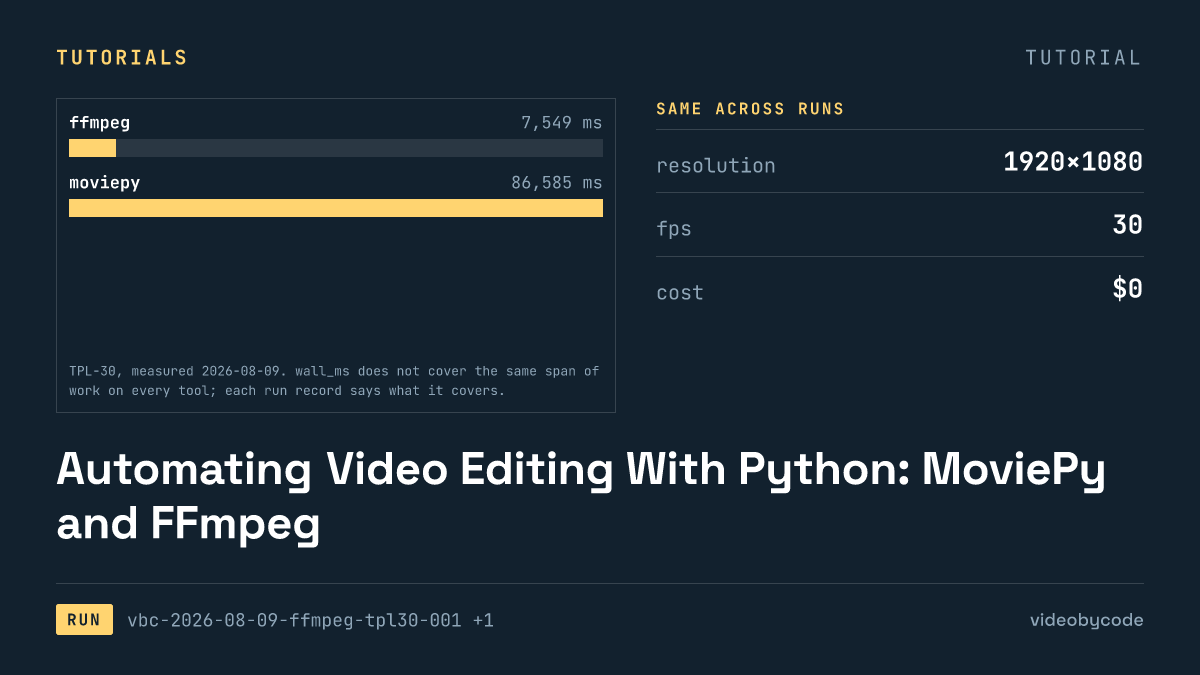
The FFmpeg run finished in 7.5 s, MoviePy in 86.6 s, Remotion in 18.2 s, and Editframe in 17.9 s, all measured with ffmpeg 8.0.1 (libx264, aac; libfreetype=no) on the same arm64 machine. Each figure except the bare FFmpeg run covers the tool's full invocation, not just encode time.
What does Editframe's free tier cover, and where does it stop?
The free tier costs nothing for companies of three employees or fewer, rendering locally or in the browser with commercial use allowed; the 17.9 s render in this article ran on that tier. It stops at a fourth employee, where a company needs Team at $49 a month or Cloud at $99 a month, per Editframe's pricing page.
Does open-source rendering software need a commercial license for paid video generation?
FFmpeg (LGPL v2.1-or-later, with some components under GPL v2) and MoviePy (MIT) both cost $0 and $0 at any volume, with no employee or revenue gate in either license. FFmpeg's own legal page notes that codec patent licensing sits outside the software license, so a commercial deployment still has to check patent status per codec on its own.
Sourcevideobycode TPL-30 verification runs(measured 2026-08-09 and 2026-08-25)
References
Ref Editframe Pricing (checked 2026-08-09)
Ref FFmpeg Legal (checked 2026-08-09)
Ref MoviePy repository (checked 2026-08-09)
Ref Remotion LICENSE.md (checked 2026-08-09)
Related articles
Build vs Buy for Video Rendering: The Cost Crossover, Calculated
Editframe, FFmpeg, MoviePy, and Remotion render the same TPL-30 template; the measured times and vendor prices show where self-hosting stops being free.
Stability AI Video API: Stable Video Diffusion From Code
Stability AI discontinued its Stable Video Diffusion API on 2025-07-24. Four compositing tools still render the same fixed benchmark today.
Meta's Video Generation API: What Is Actually Callable
Meta has not published a developer video generation API as of 2026-08-09; the vendor page describes consumer features, not a callable endpoint, key, or SDK.
Designing a Headless Video Rendering Pipeline
Editframe, FFmpeg, MoviePy and Remotion render the same template video; wall time, output size and vendor price are recorded as data, not claims.
Automating Video Editing With Python: MoviePy and FFmpeg
FFmpeg and MoviePy render the same 1920×1080 TPL-30 template; the code, exact versions, and measured render time and output size are given below.
How to Create Video With Code: A Working Pipeline End to End
Editframe, FFmpeg, MoviePy and Remotion render the same TPL-30 template; render time, output size and cost are compared with linked evidence, not vendor claims.